

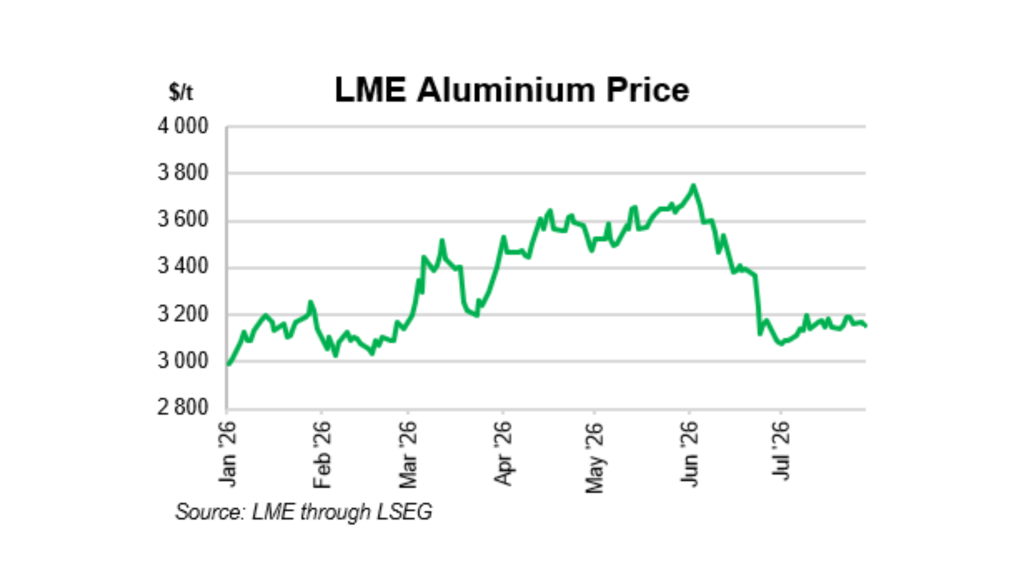
Aluminium prices surged above $3 700/t following the outbreak of the war in the Middle East in late February as regional supply was cut off from markets, but pulled back to pre‑war levels of below $3 200/t in July after the mid‑June ceasefire raised expectations that supply would soon return to markets (see graph below). But with a resolution of the war and the opening of the Strait of Hormuz still clouding the return of Middle East supply in uncertainty, ongoing ramp‑up in primary aluminium output and new smelting capacity elsewhere is expected to help ease the supply deficit created by the conflict.
The US-Iran war disrupted supply from the Middle East, responsible for nearly 10% of global aluminium output. Missile strikes damaged smelters in the UAE and Bahrain, while Qatar cut output due to natural gas shortages. However, Emirates Global Aluminium has restarted production in the UAE, to 50% capacity at Al Taweelah alumina refinery, targeting full capacity by the end of the year. Qatar Aluminium is currently reported to be operating at 60% capacity. The Strait of Hormuz, however, still remains just about shut, and it is unclear whether any of this revived production is able to be shipped to global markets.
Some relief may come from restarted production beyond the Middle East. Two idled smelters have been revived. In Slovakia, Hydro’s Slovalco JV has agreed with the Slovak government to restart 75kt of its 175ktpa capacity; the restart of the remaining 100kt will only be considered after 2030, contingent on framework conditions and the securing of additional long‑term power contracts. Also, in the US, Magnitude 7 Metals plans to partially restart 75ktpa at the New Madrid smelter by the end of the year, with further ramp‑up possible in 2027.The US government has also announced an incentive programme to discount Section 232 tariffs on imported primary aluminium for companies investing in domestic smelting. In the medium term, this scheme aims to revive US aluminium smelting capacity and reduce heavy reliance on imports.
Fighting in the Middle East has paused again following a resumption of hostilities, but it remains to be seen if a more enduring solution to the conflict can be found. Aluminium markets will keep a keen eye on the Strait as well as ramp-ups in Slovakia and the US to determine if the hopes for higher supply was premature, with disappointment sure to send prices higher again.
For more on the outlook for Aluminium; see our Aluminium forecasts.
Compiler: Dina Alleluya (dina@afriforesight.com)