


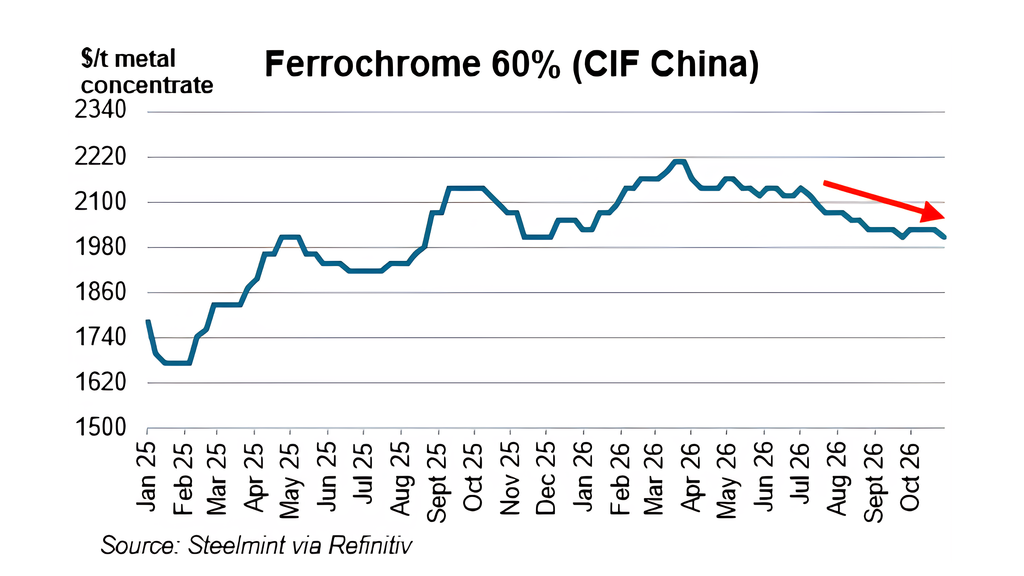
Ferrochrome prices continue to face downward pressure (see graph) as weak Chinese stainless steel demand runs into elevated, if declining, domestic production at a time that more South African smelters are returning to operations.
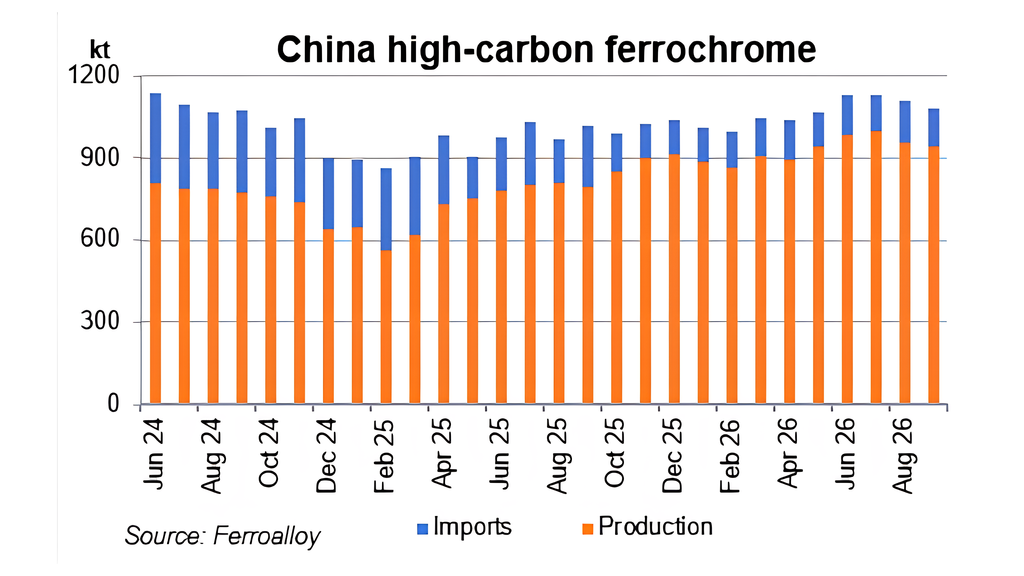
Chinese high-carbon ferrochrome production declined by 3.3% month-on-month in October. But these cuts come after a steady increase in output over the year, with production over the first 10 months of 2026 still up 15.9% from the same period the year before, ensuring ample supply in the market.
For South Africa, however, the ferrochrome story is beginning to change. An agreement between major producers and with Eskom concluded in a month settled on a much reduced 62c/kWh electricity tariff, providing considerable relief to an industry that has struggled to compete with Chinese producers on electricity costs.
The agreement has kick-started a revival in domestic ferrochrome production. Glencore-Merafe restarted its state-of-the-art Lion smelter in Month, with its Boshoek and Wonderkop smelters also now firing up in September and October, respectively – both are expected to ramp up through the fourth quarter. Merafe’s attributable ferrochrome production reached 61kt in the first 9-months of 2026, down 46% from 112 kta year earlier. This highlights just how much production was lost during the prolonged shutdowns, but also the potential for a substantial recovery as the furnaces return.
Samancor Chrome is also an important part of the recovery story. Following the electricity tariff agreement, the company cancelled its retrenchment notice in June and indicated its intention to resume production across its smelters within six months.
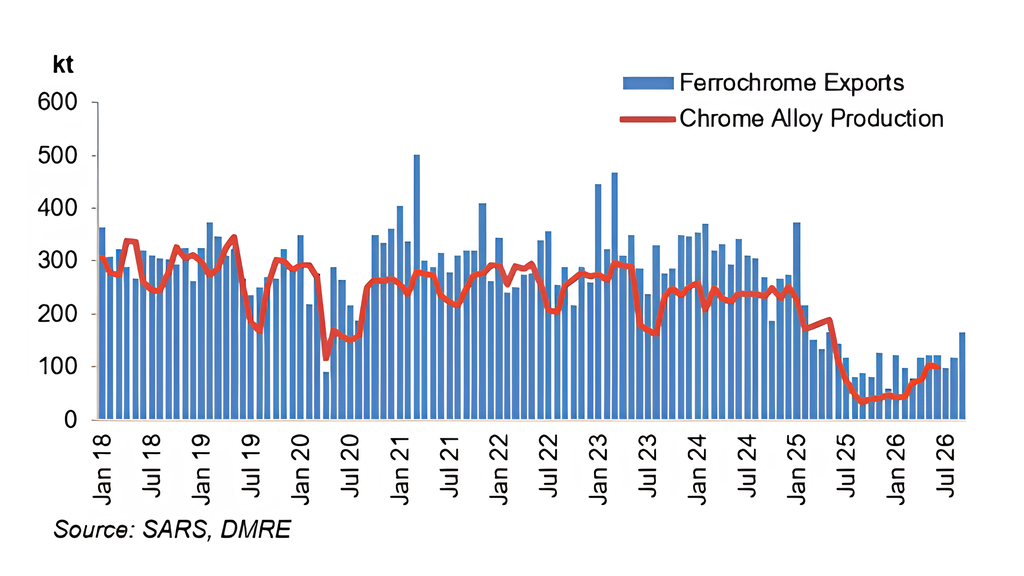
The increase in available South African material is already reflected in export figures – see graph. Ferrochrome exports rose 41.6% month-on-month to 166.2kt in September, with China returning as the largest destination. This is an encouraging development for South African producers, but it comes with a caveat: South Africa is returning to a market that remains well supplied by Chinese domestic production. South African export availability could increase further just as Chinese demand remains uncertain.
The contrast between the two markets is becoming increasingly important. South Africa is working to restore its smelting industry through lower electricity costs, while China is struggling to balance high ferrochrome output with weaker stainless-steel demand. For Merafe and Samancor, the lower tariff creates an opportunity to restore production and improve capacity utilisation; for the wider market, however, additional South African supply could make an already difficult price environment more challenging. The real test will be whether China’s demand can keep pace with South Africa’s returning furnaces.
For more on the outlook for Ferrochrome; see our Ferrochrome forecasts.
Compiler: Khomotso Rabutla (khomotso@afriforesight.com)