

The iron ore market entered the 2nd half of 2026 with mixed signals. China is producing less steel as its property sector remains weak, yet imports remain firm because of lower domestic ore output and inventory building. This has supported prices, but the supply outlook is strengthening as Brazil expands and Guinea ramps up production, while Australian output remains strong. Company results reflect this balance: production remains strong and EBITDA margins are still attractive, despite generally narrowing in the 1st half of 2026.
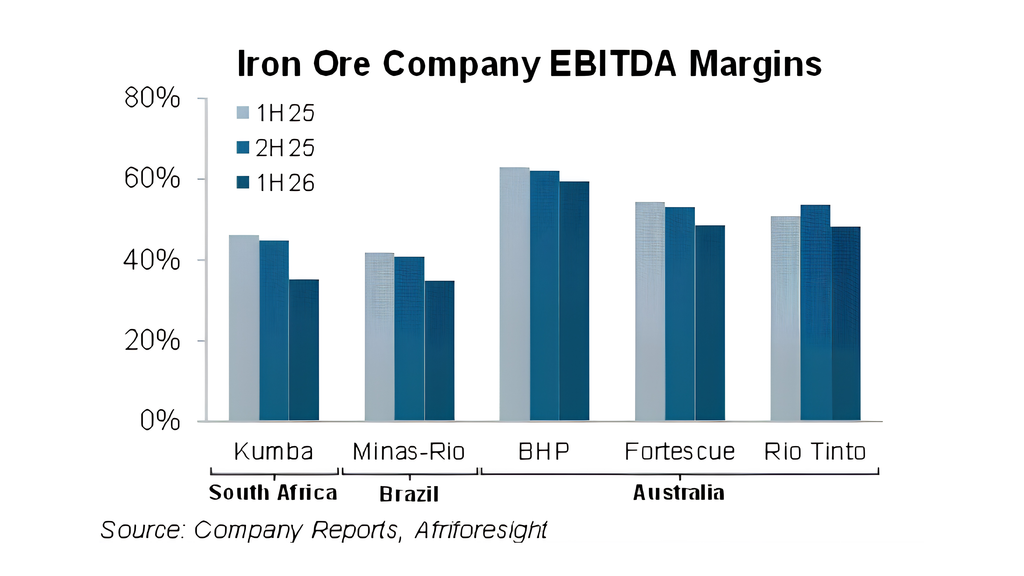
Australia remains the industry’s production engine. BHP achieved record Western Australian production and shipments in the year ended June 2026, while Fortescue also delivered record annual shipments. Rio Tinto showed its strongest 1st-half Pilbara production since 2018. Margins softened in the 1st half 2026 but remained stronger than in the rest of the world, highlighting the producers’ low costs and efficient operations. Some lower-grade fines attracted discounts because steelmakers need more ore and coke to produce the same amount of steel. China’s purchasing restrictions on certain BHP and Fortescue products also temporarily widened discounts.
Brazil is entering a new phase of supply growth. Vale recorded its strongest 2nd-quarter output since 2018, supported by record production at S11D, project ramp-ups and the restart of Água Limpa. Production at Anglo American’s Minas-Rio was broadly stable in the 1st half of 2026, although lower grades reduced 2nd-quarter recoveries and its EBITDA margin narrowed. Brazil’s higher-grade ore remains an advantage because it improves furnace efficiency and requires less fuel.
South Africa faced a more difficult 1st half of 2026. Anglo American’s Kumba continued to earn a premium for its high-grade ore, but its EBITDA margin fell sharply because of higher costs, lower sales and weaker export pricing. Rail and port reliability remains crucial: Kumba can only benefit fully from its ore quality if it can move production efficiently to Saldanha Bay.
Guinea became an active exporter during the 1st half of 2026, with Rio Tinto completing its first commercial sales of high-grade Simandou ore in April. Initial volumes remain small, but the project is opening another major source of premium ore. This will reduce China’s reliance on Australia and Brazil and increase competition as production ramps up.
The market is therefore becoming more competitive. Australia remains at high production levels, Brazil is adding supply, South Africa is trying to protect margins and Guinea is beginning a major ramp-up. China’s restocking and infrastructure spending may provide temporary support, but growing supply and weak construction demand should pressure prices and gradually narrow margins. Even so, low-cost producers with reliable logistics and higher-quality ore should continue earning attractive returns.
For more on the outlook for Iron Ore; see our Iron Ore forecasts.
Compiler: Devon Allers (devon@afriforesight.com)