

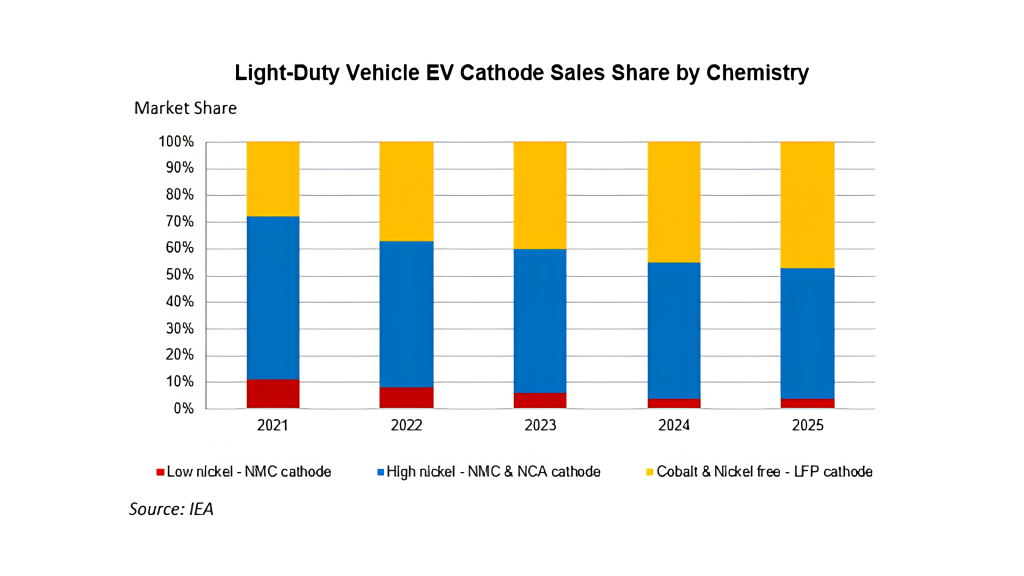
The global electric vehicle (EV) battery market is undergoing a structural shift, as lithium iron phosphate (LFP) batteries continue to gain market share at the expense of nickel-rich chemistries such as nickel-cobalt-manganese (NCM) and nickel-cobalt-aluminium (NCA). Once, LFP’s were largely confined to entry-level vehicles in China, but it has become the preferred chemistry for an increasing proportion of passenger EVs due to their lower cost, improved durability and enhanced safety.
LFP batteries accounted for more than 50% of global EV battery demand for the first time in 2025, with adoption continuing to expand into Europe and North America as automakers prioritise affordability. In both regions, LFP batteries are primarily sourced from China, with Tesla playing a central role, accounting for 85% of LFP battery-powered EVs produced in the US and almost 50% of those sold in the EU. Of Tesla’s LFP EVs sold in the EU, over 50% are produced in Germany, with the remainder imported from China.
The rapid growth of LFP batteries is being driven by both technological improvements and changing market economics. LFP cells contain no nickel or cobalt, significantly lowering production costs and reducing exposure to volatile critical mineral markets, while advances such as cell-to-pack integration and blade battery designs have narrowed the historical energy density gap with NCM batteries, making NCM and LFP driving ranges comparable.
At the same time, several automakers and battery producers, including LG Energy Solution and Samsung SDI, have acknowledged that slower-than-expected EV demand and increasing price competition are placing pressure on high-nickel battery margins, prompting greater investment in lower-cost LFP battery technologies.
Despite losing market share, nickel-rich chemistries are unlikely to disappear completely because they continue to offer superior energy density and longer driving ranges for some premium passenger vehicles, large sport utility vehicles and heavy-duty commercial transport. Instead, the battery industry is becoming increasingly segmented, with LFP dominating mass-market passenger vehicles and stationary energy storage systems, while NCM, NCA and emerging manganese-rich chemistries focus on applications where higher performance outweighs higher costs.
For mining companies, this transition has significant implications: lithium demand is expected to remain structurally strong, iron phosphate production is expanding rapidly, while long-term growth in nickel and cobalt demand from passenger EV batteries is becoming more uncertain as manufacturers increasingly reserve these metals for higher-value applications. The global battery market is therefore no longer defined by a single dominant chemistry; instead, competitiveness will increasingly depend on matching battery chemistry to vehicle application and costs.
For more on the outlook for EVs; see our EVs forecasts.
Compiler: Kirthi Ramdhanee (kirthi@afriforesight.com)