

The battery recycling industry is becoming an increasingly strategic component of critical-mineral supply chains, as governments seek to retain recoverable lithium, nickel, cobalt and other battery materials within domestic markets. The push to expand recycling capacity plays out against the background of increasing trade conflict between the US and China, with the latter already weaponizing its control over critical mineral supply to force concessions in negotiations.
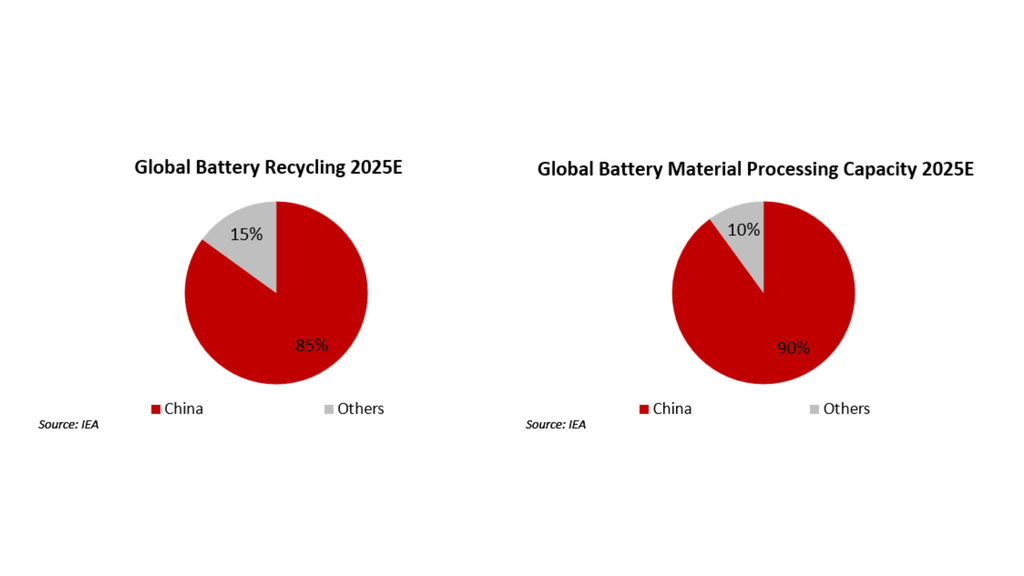
China accounts for more than 85% global battery recycling, 75% of global battery pre-treatment capacity and around 90% of battery material processing capacity. Manufacturing scrap remains the main source of recycling material, with most batteries for new energy vehicles (NEVs) and energy storage deployed in recent years yet to reach end of life.
The US is now trying to play catch-up, strongly pushing to reduce reliance on overseas processing, particularly China, and treat recycled battery materials as a strategic domestic resource. On 27 August, the US implemented restrictions on exports of battery waste, including black mass produced from shredded lithium-ion batteries, for 1yr. The US hopes that its export restrictions will create a clear incentive to build domestic hydrometallurgical refining capacity, which lags behind capacity already in place for collection and shredding.
Recycling’s contribution to critical-mineral supply is expected to increase substantially as EV and energy-storage batteries reach end of life, but the economics will vary significantly between chemistries, with lower-value LFP batteries presenting a greater challenge for conventional recycling models than nickel- and cobalt-rich batteries.
This means that future battery-material supply will increasingly depend on the interaction between primary mining, battery chemistry, collection rates, recycling capacity and government-controlled material flows, rather than mine production alone. For mining companies, recycling is unlikely to displace primary supply in the near term, but the rapid politicisation of black mass demonstrates that the material contained in today’s batteries is increasingly being treated as a strategic resource.
For more on the outlook for Battery materials; see our Battery materials forecasts.
Compiler: Kirthi Ramdhanee (kirthi@afriforesight.com)