

Chinese steel mills are under growing pressure as weak demand and higher production costs continue to squeeze margins. The proportion of profitable mills has fallen sharply in recent months, even as iron ore prices have dropped towards $90/t. Despite narrowing margins, steel production has held up relatively well, raising concerns about how long mills can maintain current output levels.
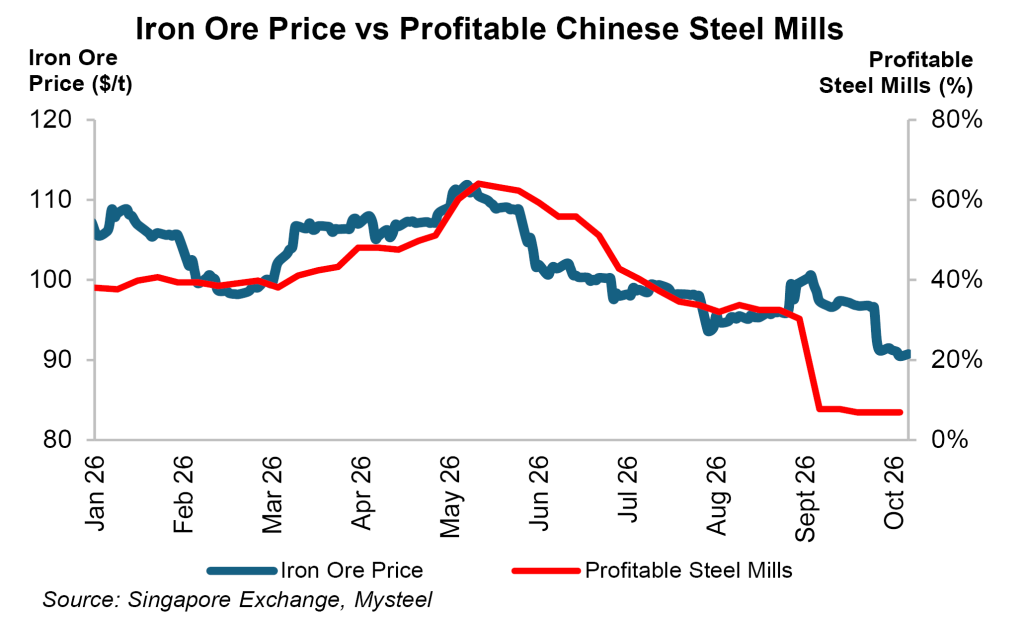
Steel mill profitability improved during the first few months of 2026, alongside stronger iron ore prices. However, this trend reversed as the year progressed, with the number of profitable steel mills falling from its May peak of 64% to just 7% by early October, according to Mysteel’s survey of 247 Chinese steel mills. Iron ore prices followed a similar downward trend, weakening to around $91/t as concerns over Chinese steel demand continued to weigh on the market.
Much of the pressure on steel mill margins comes from weak demand and higher production costs. China’s struggling property sector and slow construction activity have continued to weigh on steel consumption, making it difficult for mills to raise selling prices. At the same time, coke prices increased during August and September as mine safety inspections and slow production restarts tightened coking coal supply. Some coke producers also reduced output as their own margins came under pressure. Although iron ore prices have fallen, the savings have not been enough to offset these higher costs, leaving most mills unprofitable.
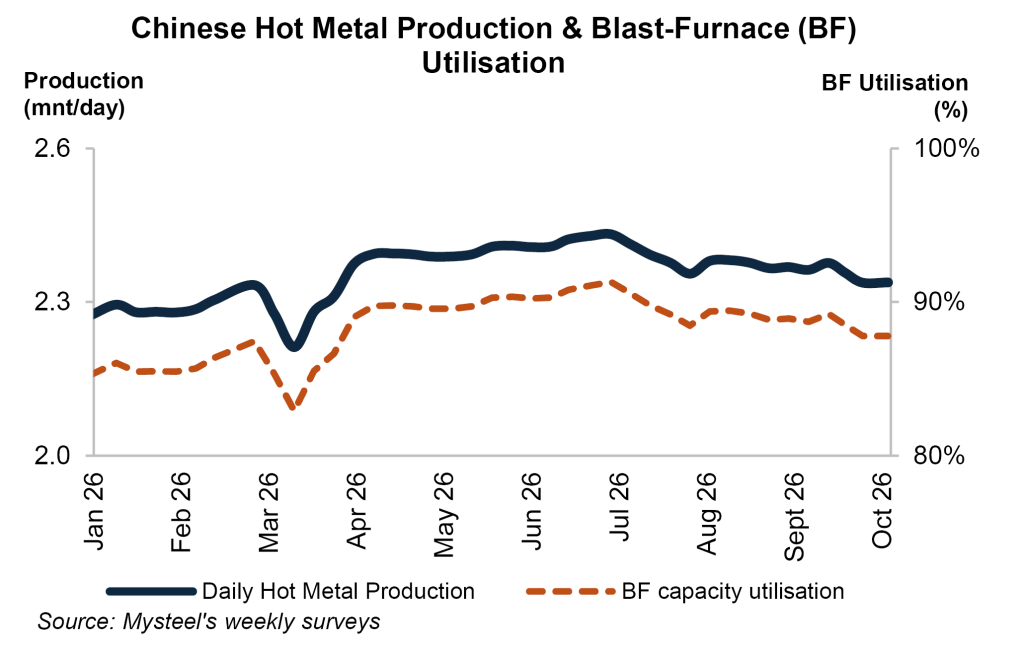
Despite these losses, Chinese steel production has not fallen nearly as sharply (see graph below). Daily hot metal production has declined by only around 4% from its June peak, while blast-furnace capacity utilisation remains close to 88%. This has helped support iron ore demand, even as mill profitability has deteriorated. However, some mills have already started planning maintenance or reducing output to limit losses. If profitability remains weak, further production cuts could follow, putting additional pressure on iron ore demand and prices.
There are some signs that conditions could improve. Chinese steel mills began cutting coke purchase prices at the start of October, which could help ease production costs and improve margins. Iron ore demand could also receive some support as mills replenish inventories following China’s Golden Week holiday, although initial restocking has been weaker than expected. Meanwhile, strong Australian shipments, recovering Brazilian production and growing supply from Guinea’s Simandou project are expected to keep pressure on iron ore prices.
Looking ahead, the main concern for iron ore demand is whether China can continue maintaining production despite weak profitability. Lower coke costs could provide some relief, but without a meaningful recovery in steel demand, further production cuts remain a risk. Combined with increasing supply, this could keep iron ore prices under pressure through the remainder of 2026.
For more on the outlook for Iron Ore ; see our Iron Ore forecasts.
Compiler: Devon Allers (devon@afriforesight.com)