

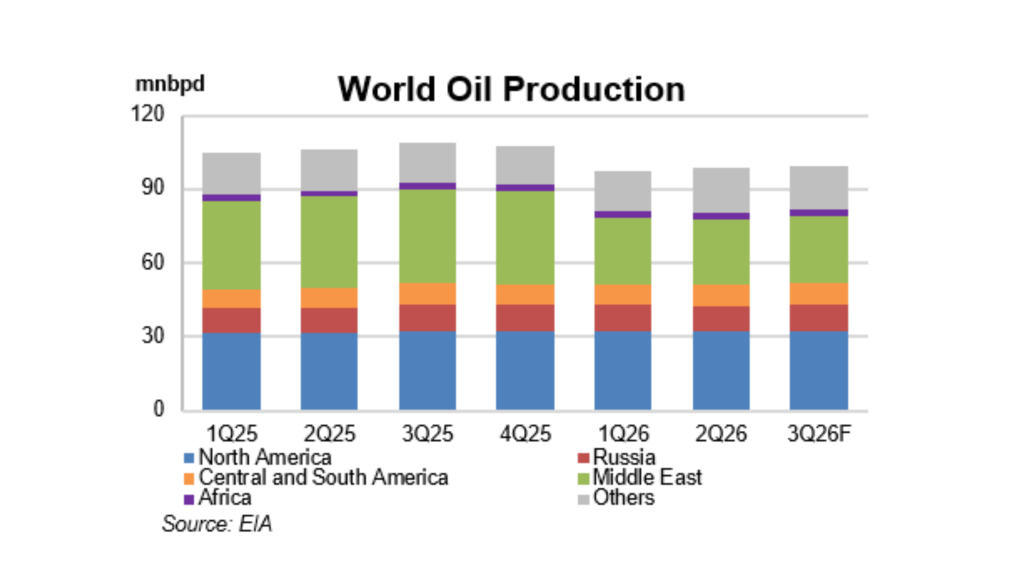
The war in the Middle East has severely curbed oil production in the Middle East (see graph), as producers were forced to cut output as exports through the Strait of Hormuz, through which 20% of global supply was previously shipped, were effectively blocked – all told, about 10mnbpd of Middle East supply has been shut in.
Although Saudi Arabia and the UAE have managed to export about 5mpbpd of crude oil through pipelines that bypass the Strait and other Gulf producers are sneaking another (difficult to confirm) 5mbpd through the Strait on ships turning off their transponders, global demand (outside of China) is holding strong, forcing the rest of world to look for alternative oil sources.
With the Middle East supply severely constrained and Russian barrels broadly sanctioned and its energy infrastructure under incessant Ukrainian attacks, the world looked to North America, South America and Africa to increase output. But even with higher oil prices to incentivise production, most of the 2026 output increases have come from Brazil.
In North America, the US was already the world’s largest oil producer. While the US continues to increase production, this has been at a relatively slow pace in 2026, with the bulk of its increased exports sourced from its release from strategic reserves – US shale producers typically face relatively high production costs and are cautious having burnt their fingers with overproduction during the shale boom years. Canada produces oil mainly from its tar oil sands, which are fairly inflexible and while it plans to increase oil output, Canada is currently still producing inline with 2025 levels.
Central and South America has seen a significant output increase, led by Brazil with Argentina chipping in too – Brazil has increased its production by 20% since the start of the year, with the increase largely driven by projects that were already in the process of ramping up; Argentina’s production, though smaller, hit a record level of 1.1mbpd as it increasingly develops its shale fields. Guyana has been ramping up output from its offshore blocks since 2020, now reaching about 1mnbpd.
Africa has also ramped up production, but to a much smaller volume than South America: Nigeria & Angola have broadly held output around 2025 levels. Years of underinvestment in their oil sectors make it difficult for Nigeria or Angola to significantly increase production, despite Angola quitting OPEC.
While the output increases from Brazil, Argentina and Africa have helped to reduce the global supply deficit, global oil production remains about 8mnbpd below 2025’s levels. Ramp ups from outside of the Middle East are preventing global oil prices from rising further for now, but are unlikely to be able to fully replace lost volumes. And with storage levels drawing down across the globe, only an end to the Iran war could bring a short term fix to the global oil supply problem.
For more on the outlook for Oil; see our Oil forecasts.
Compiler: Vinesh Chetty (vinesh@afriforesight.com)